

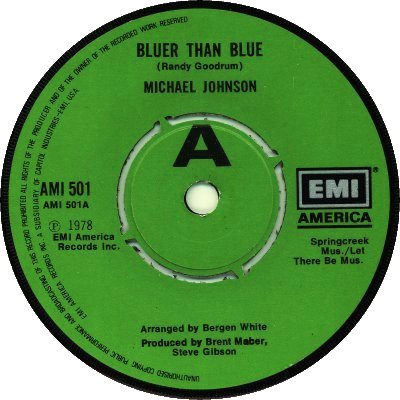
Unsurprisingly, EMI America was one of EMI's outlets for American material. Its first mention in 'Music Week' came in the issue of the 24th of December 1977. According to the article it was to be based in Los Angeles, was to have its own label identity in both Britain and the States, and was intended to be an 'independent source for top American talent for the world markets'. It was to be handled by the staff who were already responsible for Capitol Records, and Jim Mazza was to be the man in charge. The first product was expected to be released in the USA in March. Michael Johnson's 'Bluer That Blue' b/w 'Two In Love' actually came out in April in that country, and was a Top 20 hit; it was issued on the 26th of May in Britain, numbered AMI-501, but failed to trouble the Charts here. Incidentally the AMI prefix became plain AM with the release of the third single There was some movement of product in the other direction: Kate Bush was on EMI here but on EMI America in the States.
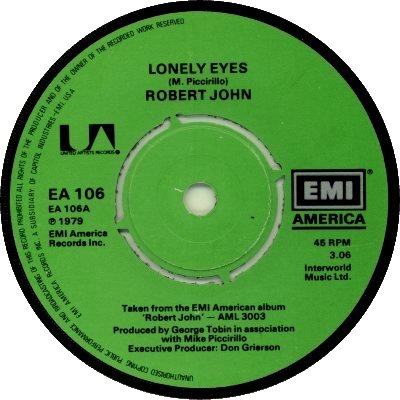
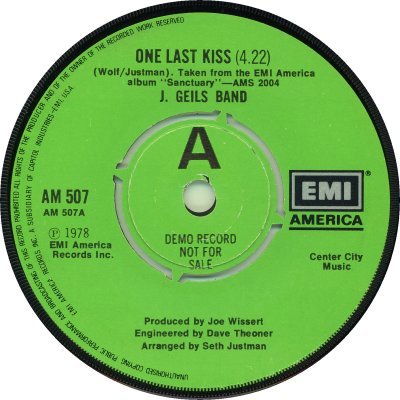
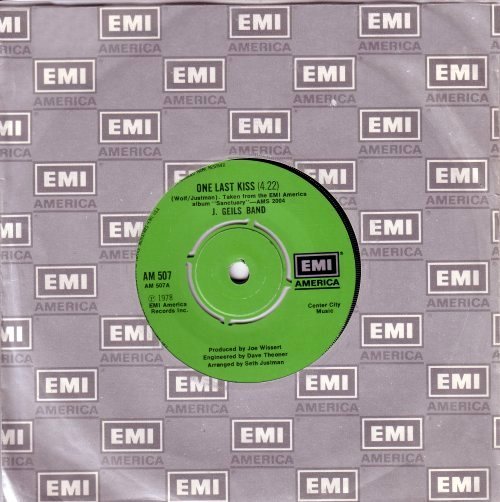
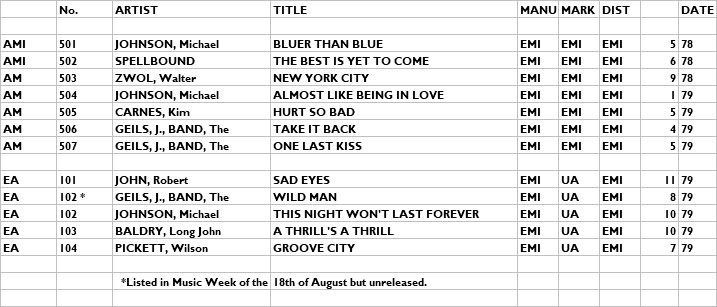
EMI America was destined not to remain associated with Capitol for long. In the early spring of 1979 EMI acquired Liberty / United Artists Records, which it renamed Liberty / United; shortly afterwards 'Billboard' of the 24th of March announced that an 'Upper management merger' between that company and EMI America was to take place. Mazza would be president of both companies, and EMI America was to shift its headquarters to that of United Artists, in Sunset Boulevard, but the two labels would remain autonomous. 'MW' of the 7th of April reported that all EMI America repertoire was being transferred to Liberty / United, but confirmed that the releases of the two companies would be kept separate. In 'MW' of the 12th of May, EMI chairman John Reed said that the music industry was becoming ever more reliant on international material, which was why EMI had invested large amounts of money both in Capitol and EMI America in the USA. A sign of the link between United Artists and EMI America came in June, when both were given new catalogue series for the UK; EMI America's changed from the AM-500s to the EA-100s ('MW', 16th June). Shortly afterwards, with EA-102, the UA logo was added to the EMI America label. Even with the changes, EMI America failed to make a huge impression here in the '70s. The J. Geils Band stalled at No.74 with 'One Last Kiss' b/w 'I Can't Believe You' (AM-507; 5/79), and while Robert John did better with 'Sad Eyes' b/w 'Am I Ever Gonna Hold You Again' (EA-101, 7/79), reaching No.31, it wasn't until the new decade when the capture of David Bowie from RCA in 1983 gave the label a frequent and consistent hit-maker. EMI America continued on into 1988, when it was merged with another EMI label, Manhattan.
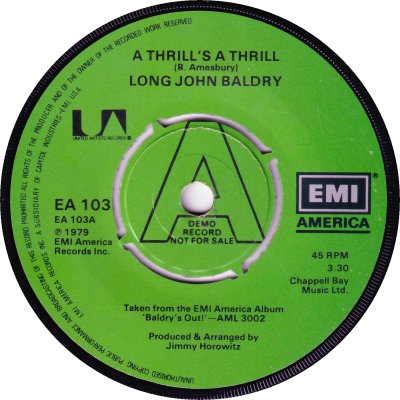
One label design served EMI America from its launch until February 1981, when the rather plain green design (1) was replaced by a more ambitious multicoloured one. Singles from EA-102 to EA-109 had a United Artists logo on them (2) and demos with a large hollowed-out central 'A', in the United Artists style (4). Previous demos had been in the usual EMI style, with a black 'A' and 'DEMO RECORD NOT FOR SALE' on them (3). Without the wording the 'A' merely indicates the appropriate side (1). Manufacture and distribution were naturally by EMI. The discography below only covers 1978-79.


Copyright 2006 Robert Lyons.