

Marc Bolan's own label, devoted to his music. T. Rex Records was founded by Bolan so that he could have complete artistic control over his own product; apparently there had been arguments with Fly, his previous company, over what should be released. 'Billboard' of the 15th of January 1972 broke the news that Bolan's band T. Rex had signed a three-year licensing deal with EMI for the UK, a deal which included the band being given its own label. The label design was to feature a picture of Bolan; 'BB' noted that the only other EMI artists to have that honour were John Lennon, Paul McCartney and Grand Funk Railroad. There was a possibility of the company's name being the T. Rex Wax Co., but by the time that 'BB' of the 22nd of January revealed that its first single was to be rush released immediately the name had been settled upon as T. Rex Records.
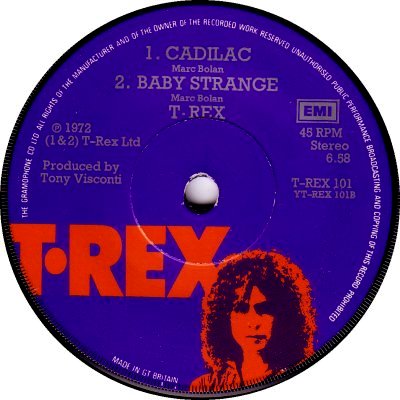
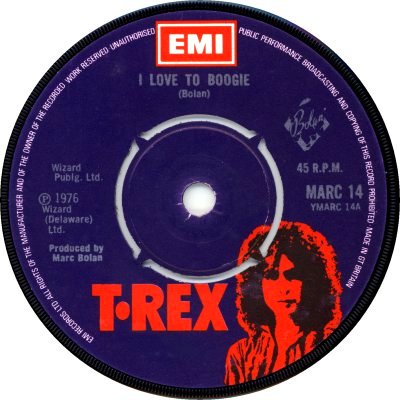
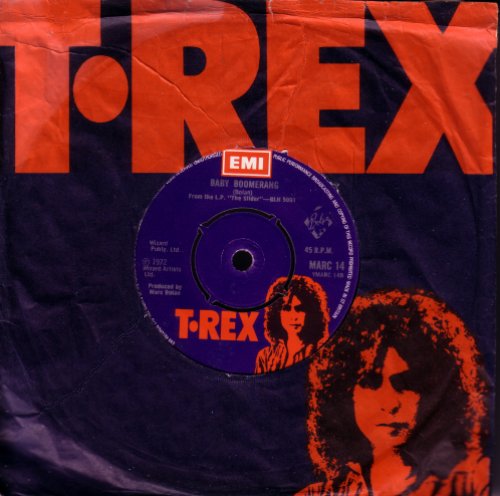
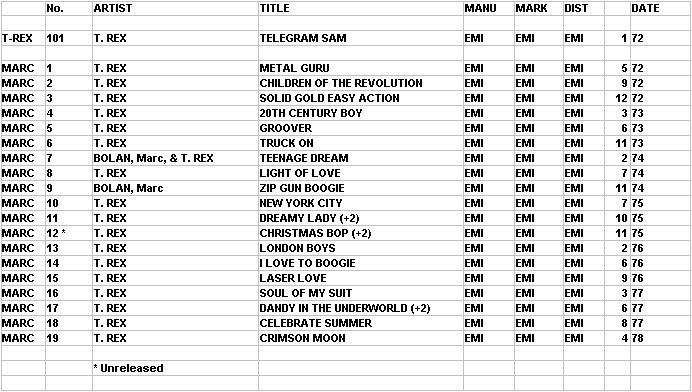
The new label hit the ground running. Its first release, 'Telegram Sam' b/w 'Cadilac' and 'Baby Strange' (T-REX 101; 1/72) went to No.1 in the Charts, as did its second, 'Metal Guru' b/w 'Thunderwing' and 'Lady' (MARC-1; 5/72), and all of the next four entered the Top 5. The seventh and eighth failed to make the Top 10, however. The ninth peaked just outside to Top 20, and for the remaining ten singles reasonable Chart placings rather than high ones were the rule. 'I Love To Boogie' b/w 'Baby Boomerang' (MARC-14; 6/76) hinted at a return to form, reaching the No.13 spot, but none of the following three singles made it into the Top 40. Sadly, Bolan's premature death in September 1977 ruled out the chance of another comeback. A final single of the '70s, 'Crimson Moon' b/w 'Jason B. Sad' (MARC-19; 4/78) was released posthumously but it didn't enjoy any Chart success.
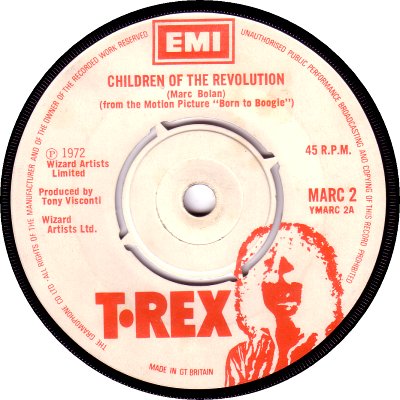
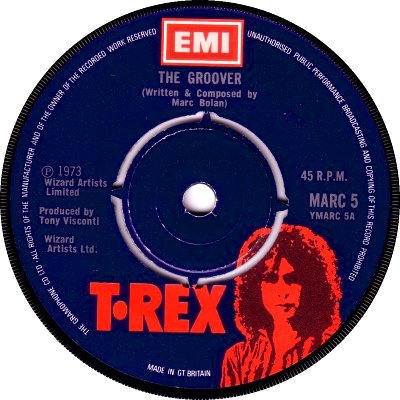
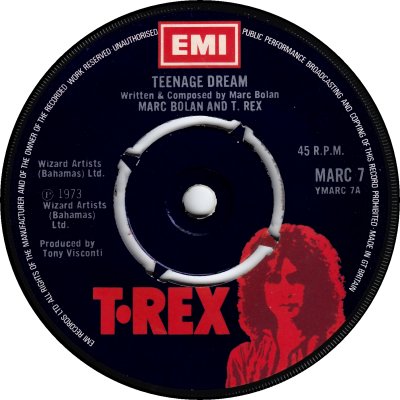
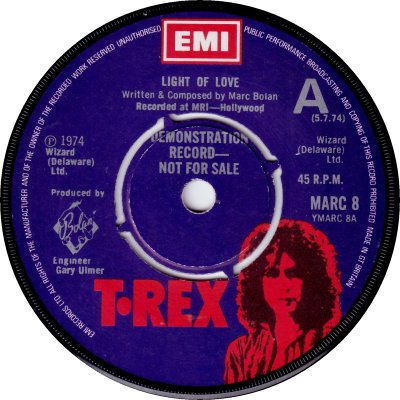
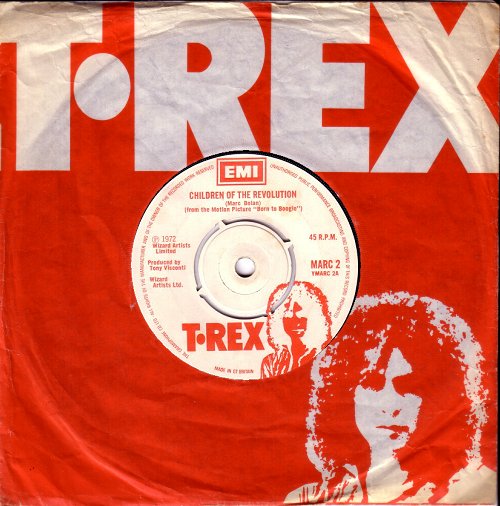
As far as numbering is concerned, an initial T-REX-100 series (1) was replaced by a MARC-0 one after only one issue; the label's design appears to have been tweaked slightly at the time of the changeover, with a different font being used and the logo shrinking a little (3). The third single had a white label with red printing (2). Philip Robinson has kindly written in to say that the initial intention was for the colours to be different for each single but that cost considerations led to that being ruled out - thanks to him for that and for other information on this page. From MARC-3 till MARC-19 the standard colouring was silver printing and a red logo on various shades of dark blue. There was an alteration in the perimeter text at the start of 1974, starting with MARC-7. In line with other labels in the EMI group the reference to 'The Gramophone Co.' at 8 o'clock was changed to refer to 'EMI Records', and at the same time the 'Made in Great Britain' at the bottom migrated to 5 o'clock (4). Other than that, the basic design remained unchanged. Occasionally custom pressings were done by other firms, which resulted in non-EMI pressing marks - the fifth scan above, with its comparatively wide dinking perforations and prominent 'polo mint' around the spindle hole, is of a Decca pressing. Demos were in the standard EMI style of the time, with a solid 'A' and the legend 'Demonstration record - not for sale' overprinted on issue labels (6). Unlike the issue copies these are rare and tend to be sought-after. The red-and-white company sleeve can apparently be found on at least two blue-labelled records, presumably thanks to EMI's using up spare old stock. MARC-12 was planned but not released; a few labels exist.
The T. Rex label was revived in 1982 for a short series of reissue EPs, again with manufacture and distribution by EMI. Numbers picked up where they had left off, at MARC-20, and a variant of the red-on-white label was used. Demo copies of these EPs featured only two tracks.

Copyright 2006 Robert Lyons.